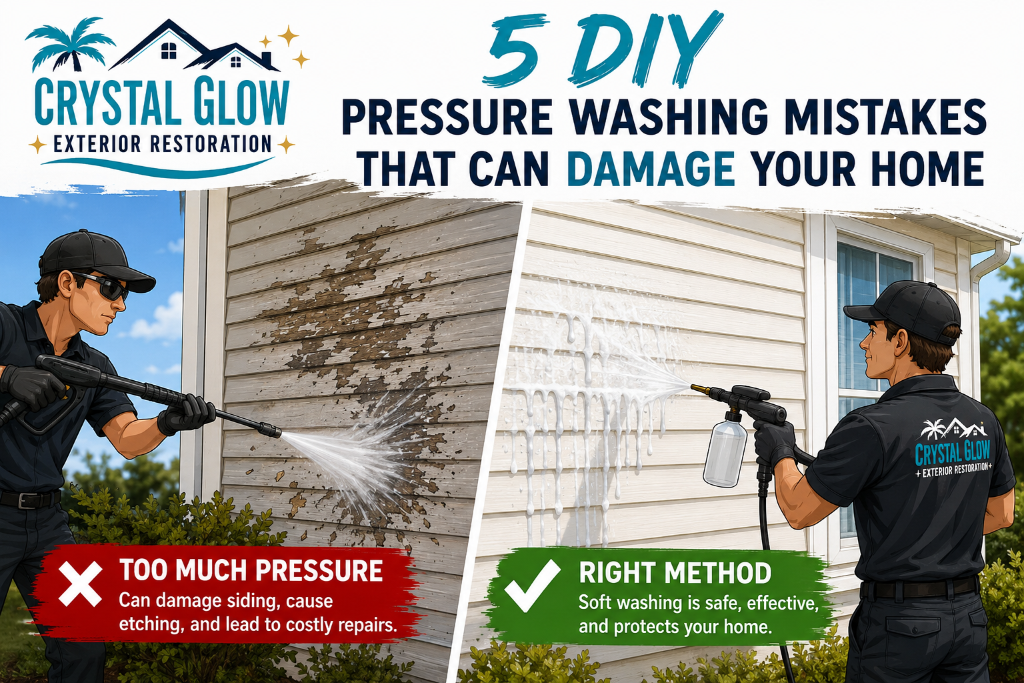
Florida's humidity, coastal salt air, and frequent storms make exterior cleaning a near-constant need for homeowners across the state. It's tempting to rent a pressure washer and tackle the job yourself over a weekend, but a few common mistakes can turn a quick cleanup into a costly repair. Below, we expand on the five DIY pressure washing mistakes that can often lead to home damage, and explain how Crystal Glow Florida approaches each area differently.
1. Assuming More Pressure Is Better
One of the most common misconceptions in DIY pressure washing is that turning up the pressure will get the job done faster or better. In reality, excessive pressure can etch concrete, damage wood, and strip protective coatings from siding and trim. Different materials, and even different conditions of the same material, require different approaches. A weathered wood fence and a newer vinyl surface are not treated the same way, and applying uniform pressure across a property can create problems that weren't there before.
Crystal Glow matches equipment, pressure, and treatment to the approved material and its condition. This means an assessment happens before any cleaning begins, so the approach fits the surface rather than the other way around.
2. Treating Roofs as Part of a House Wash
Many homeowners assume that a house wash automatically includes the roof, but that is not the case. Roof cleaning is not included in our house wash. Roofline down refers only to the included exterior walls, soffits, fascia, and exterior gutter faces, where accessible and suitable for cleaning. If black streaks, algae, moss, or lichen have appeared on the roof itself, that is a separate consideration.
A soft wash roof cleaning approach, when appropriate, uses low-pressure application of a suitable cleaning solution to treat organic growth, followed by a gentle rinse intended to protect shingles, tiles, and metal roofing. High pressure is never used on the roof. Any separate roof service requires process confirmation, since roof material and condition vary widely from home to home.
3. Ignoring Sensitive Areas
DIY pressure washing often skips a step that professionals treat as essential: preparing the work area before any cleaning solution or pressure touches the surface. Landscaping, delicate trim, outdoor fixtures, and other sensitive areas can be affected by runoff, overspray, or direct contact with equipment.
Our house-wash process starts with inspection and preparation, including wetting nearby landscaping and protecting sensitive areas as appropriate, before low-pressure solution application and rinsing. Skipping this step is one of the more overlooked ways a DIY project can lead to unintended damage to plants, fixtures, or nearby surfaces.
4. Treating Glass Like Concrete
Windows and concrete are fundamentally different surfaces, yet many DIY approaches apply the same pressure washer nozzle to both. Glass is far more delicate, and a hard-surface pressure-washing method is not appropriate for it. Our exterior window cleaning uses a Tucker water-fed pole and brush with purified water, not pressure-based cleaning. Interior windows are cleaned by hand with a window washer and squeegee, only when that service is included in the package.
This distinction matters because glass, frames, and screens each require their own care. Screens, where accessible and included, are removed, cleaned, and reinstalled as part of the process rather than sprayed in place.
5. Expecting Every Stain to Disappear
A common frustration in DIY pressure washing is discovering that some stains simply will not come out, no matter how much time or pressure is applied. Oil, rust, irrigation stains, paint, and permanent discoloration may remain after hard-surface cleaning. These are not always signs of a failed cleaning, but rather a reflection of how deeply certain substances can penetrate porous materials like concrete or pavers.
Similarly, hard-water deposits, scratches, etching, paint, and construction debris on glass require assessment and may need a separate specialty service. Setting realistic expectations before starting a project can prevent frustration and repeated attempts that risk further surface damage.
Surface Cleaning Requires Its Own Approach
Driveways, sidewalks, patios, walkways, and pool decks each respond differently to cleaning, which is why professional surface cleaning uses a surface cleaner for broad areas and detail edges as needed, with pressure and treatment matched to the material and its condition. Pavers, in particular, require a material-specific assessment before any cleaning begins, since their joints and surface texture behave differently than poured concrete. Sanding and sealing are separate services unless expressly listed in the quote, so it's worth asking what is and is not included before assuming a full refresh is part of the job.
Define the Scope Before Work
Only the services and cleaning areas listed in the quote are included. This applies to every part of the property, from roofline-down house washing to surface cleaning and window care. Before starting any project, ask about suitability and limitations rather than assuming every area receives the same treatment. A clear scope helps avoid surprises and sets realistic expectations for what a cleaning can and cannot achieve.
Ready for a Second Opinion?
If your DIY pressure washing project didn't go as planned, or if you'd simply rather avoid the risk altogether, Crystal Glow Florida is here to help. Request a free custom quote today, and we'll walk through your property's specific surfaces, conditions, and needs before any work begins.
Frequently Asked Questions
Is it true that more pressure always cleans better?
No. Excessive pressure can etch concrete, damage wood, and strip coatings. Pressure and treatment should be matched to the specific material and its condition rather than maximized across the board.
Does a house wash include the roof?
No, roof cleaning is not included in a standard house wash. Roofline down refers only to the included exterior walls, soffits, fascia, and exterior gutter faces where accessible and suitable. Roof cleaning is a separate service that requires process confirmation.
Can pressure washing remove all stains from concrete or pavers?
Not always. Oil, rust, irrigation stains, paint, and permanent discoloration may remain after hard-surface cleaning, since some substances penetrate porous materials in ways that cleaning alone cannot fully reverse.
Is window cleaning done with a pressure washer?
No. Exterior window cleaning uses a Tucker water-fed pole and brush with purified water rather than a hard-surface pressure-washing method. Interior windows, when included, are cleaned by hand with a window washer and squeegee.
What should I check before starting a DIY pressure washing project?
Confirm which surfaces are suitable for pressure washing, protect sensitive landscaping and fixtures beforehand, and set realistic expectations about stain removal. When in doubt, ask about suitability and limitations before assuming every area can be treated the same way.
Ready to make it glow?
Get a Free Custom Quote Today
Ready to book tips & advice? Request a free, no-obligation custom quote tailored to your home's size and condition.